
Performance Comparison of Individual and Ensemble Methods in Modelling Maximum Air Temperature CMIP6 Dataset
Keywords:
Maximum air temperature, ensamble , PEA ROC , WEA Tay , BMA , CMIP6Abstract
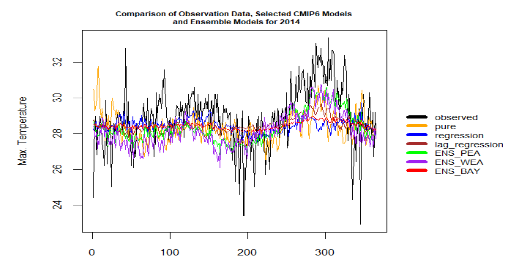
Global warming, as a trigger for climate change, has led to an increase in maximum air temperatures in both globally (represented by Global Climate Model (GCM)) and regionally (data observed in BMKG Station). This study aims to compare the accuracy of individual and ensemble methods in modelling maximum air temperatures in Malang City, Indonesia using CMIP6 dataset. A total of 19 CMIP6 models were used and processed with regression methods, lag response regression, and ensemble methods to reduce model uncertainties. The ensemble methods applied include deterministic methods and a probabilistic method. Deterministic methods consist of Performance-based Ensemble Averaging using Root Mean Square Error and Temporal Correlation Coefficient (PEA ROC) and Weighted Ensemble Averaging based on Taylor’s Skill Score (WEA Tay), while the probabilistic method is Bayesian Model Averaging (BMA). The evaluation was conducted using metrics such as RMSE, MAE, and MAPE. The best method to calibrate daily maximum air temperature data from CMIP6 in Malang City, East Java, is regression with a lagged response variable.







 Editorial Office